
Why Long‑Term Search Engine Optimization (SEO) Matters — and Why Short‑Term SEO Spamming Hurts More Than It Helps

Updated: Jun 2
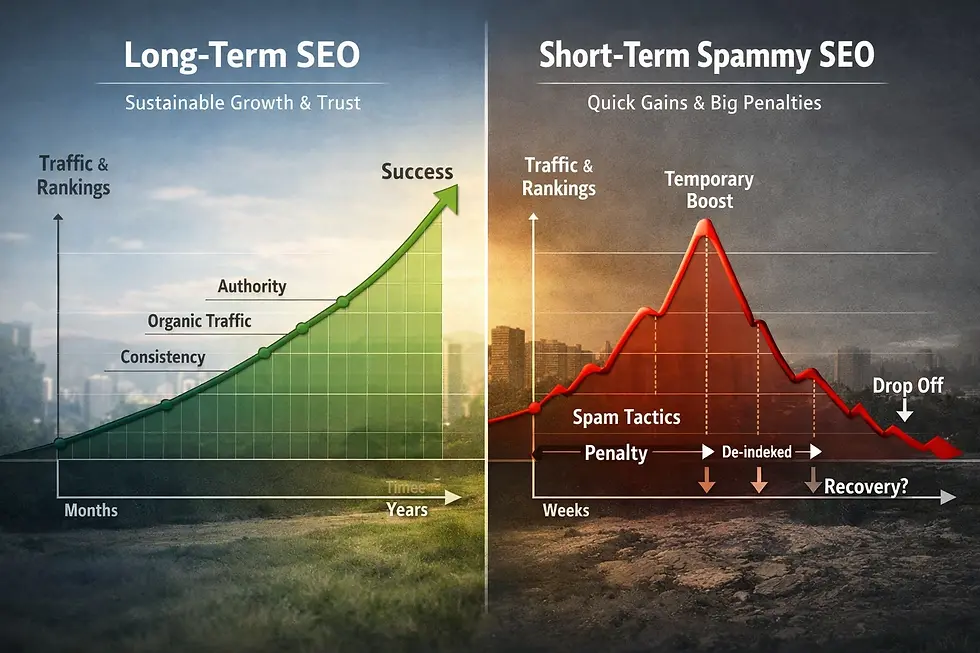
Search engine optimization (SEO) is more than a marketing tactic; it’s a long‑term investment in the health and visibility of your business. When SEO is done correctly, it becomes a durable asset that compounds over time, strengthening your brand, increasing your reach, and building trust with both search engines and real people. But when businesses chase shortcuts or rely on “quick win” spam tactics, they often end up damaging their reputation, losing rankings, and creating long‑term problems that are far more expensive to fix. Understanding the difference between sustainable SEO and short‑term spamming is essential for any business that wants to grow with stability and credibility.
Long‑term SEO works because it builds compounding visibility. High‑quality content, optimized pages, and a strong site structure continue to perform long after they’re created. Over time, this leads to higher rankings, more organic traffic, and stronger brand recognition. Each piece of well‑optimized content becomes a long‑lasting asset that continues to attract customers month after month. This slow‑and‑steady approach is what allows businesses to build a foundation that supports growth for years, not just weeks.
Another major advantage of long‑term SEO is the way it strengthens brand authority. Search engines reward businesses that demonstrate expertise, experience, authority, and trustworthiness. (Setiawan & Nendi, 2025) These signals are built through consistent publishing, helpful content, real customer reviews, high‑quality backlinks, and a positive user experience. When a business invests in these elements, it positions itself as a leader in its industry — something no shortcut or spam tactic can replicate. Strong SEO also supports every other marketing channel, improving the performance of paid ads, social media, email campaigns, and local search. It creates a unified ecosystem where all marketing efforts reinforce one another.
Long‑term SEO also attracts high‑intent customers — people who are actively searching for the services or solutions you provide. By showing up for problem‑aware searches, service‑specific queries, and local “near me” results, businesses connect with customers who are already close to making a decision. These visitors convert at a much higher rate than cold traffic, making SEO one of the most cost‑effective long‑term strategies available. (Team, 2026)
On the other hand, short‑term SEO spamming creates more harm than good. Tactics like keyword stuffing, low‑quality AI‑generated content, buying backlinks, using link farms, cloaking, fake reviews, and mass‑produced doorway pages may create a temporary spike in traffic, but the consequences are severe. Search engines have become extremely strict about spam, and businesses that use these tactics often face ranking drops, manual penalties, de‑indexing, and long recovery times. Once a domain loses trust, rebuilding it can take months or even years. (How Long Does SEO Take to Show Results?, 2026)
Beyond search engine penalties, spammy SEO damages a brand’s reputation. Customers can immediately recognize low‑quality content or manipulative tactics, and this creates confusion, frustration, and mistrust. Poor user experience leads to lower conversions and fewer returning visitors. (Bell et al., 2020) A business’s reputation is one of its most valuable assets, and risking it for a short‑term traffic bump is never worth it.
Short‑term spam tactics also waste time and money. They require constant churn — producing low‑quality content, buying links that eventually get removed, and repeatedly trying to “game the system.” When penalties hit, businesses must spend even more time and money cleaning up the mess. Toxic backlinks, duplicate content, thin pages, and over‑optimized anchors create long‑term technical debt that can take months to repair. (Dean, 2025) In the end, the cost of fixing spam‑based SEO is far higher than the cost of doing SEO correctly from the beginning.
The bottom line is simple: long‑term SEO builds a durable, trustworthy, high‑performing brand, while short‑term SEO spamming destroys trust, damages rankings, and creates long‑lasting problems. Businesses that commit to sustainable SEO — high‑quality content, strong site structure, real authority, and user‑first experiences — are the ones that win over time. Search engines reward consistency, authenticity, and value. So do customers.
References
Setiawan, D. & Nendi, I. (2025). Search Engine Algorithm Updates and Their Effects on Digital Content Performance. Journal of Digital Marketing and Search Engine Optimization 22. https://doi.org/10.59261/n1kh3g82
Team, C. (2026). Organic vs Paid Traffic ROI: Key Marketing Statistics 2026. ContentMation. https://contentmation.com/marketing-stats/organic-vs-paid-traffic-roi
(2026). How Long Does SEO Take to Show Results?. DeltaV Digital. https://www.deltavdigital.com/resources/blog/how-long-does-seo-take/
Bell, L., McCloy, R., Butler, L. & Vogt, J. (2020). Motivational and Affective Factors Underlying Consumer Dropout and Transactional Success in eCommerce: An Overview. Frontiers in Psychology 11. https://doi.org/10.3389/fpsyg.2020.01546
Dean, B. (2025). Duplicate Content and SEO: The Complete Guide. Backlinko. https://backlinko.com/hub/seo/duplicate-content

